Most Entrepreneurs Don't Have a Tools Problem
Open any entrepreneur's laptop and you'll find the same thing — a calendar app, a project management tool, a CRM they barely use, three note-taking apps, and a Notion workspace that made sense six months ago. Tools are not the problem.
The problem is the absence of a system that ties everything together. A system that knows where you are, tells you what to do next, connects you to the right people at the right time, and builds in the accountability to actually get there.
That's what an entrepreneur operating system is built to do.
What Is an Entrepreneur Operating System?
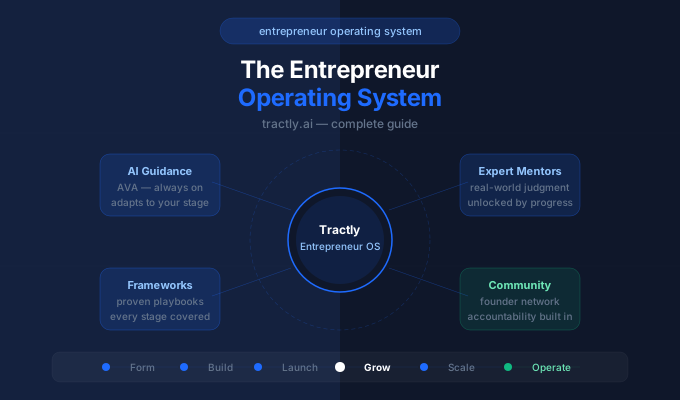
An entrepreneur operating system (EOS) is a structured platform that supports the full entrepreneurial journey — from the first spark of an idea through building, launching, and growing a real business.
It combines four essential elements into one integrated experience:
- AI guidance that adapts to your stage and recommends your next best action
- Expert mentors who provide real-world judgment at the moments that matter most
- Proven frameworks that structure every phase of the journey
- A connected community that keeps you accountable and moving forward
Unlike a single tool that solves one problem, an entrepreneur operating system addresses the entire lifecycle. It's not a project manager. It's not a course platform. It's not a mentor marketplace. It's the layer that coordinates all of those things into a coherent path from idea to operating business.
Think of it as the iOS or Android of entrepreneurship. The operating system doesn't build your apps — it creates the environment where everything works together.
Who Is an Entrepreneur Operating System For?
The short answer: any entrepreneur who wants to build something real.
Whether you're a first-time founder who has an idea but doesn't know where to start, a serial entrepreneur who wants to move faster and more systematically on your next venture, a corporate innovator who's been tasked with bringing startup execution inside a large organization, a student building for the first time and learning by doing, or a business owner who has already launched and wants to grow more strategically — an entrepreneur operating system was designed for you.
The key insight is that an entrepreneur operating system meets you where you are. You don't need to be at a specific stage, have a specific amount of funding, or belong to a specific industry. You enter at your current point in the journey and the system adapts to guide you forward from there.
The Problem It Solves
To understand why entrepreneur operating systems exist, it helps to understand what the alternative looks like.
Most entrepreneurs today are building in a fragmented world. They attend an accelerator that lasts three months and then leaves them on their own. They take online courses full of theory that doesn't connect to their specific situation. They get occasional mentor advice that's hard to apply without the broader context of their full journey. They use a dozen tools that don't talk to each other.
The result is that entrepreneurship feels harder than it needs to be. Not because the work is impossible, but because the infrastructure to support it is disconnected.
Four specific problems emerge repeatedly:
Isolation. Most entrepreneurs are building alone. Without a support system, blind spots accumulate and decisions get made without the benefit of outside perspective. The loneliness of solo building is one of the least-discussed but most common reasons ventures stall.
Lack of direction. Without a clear stage-by-stage roadmap, entrepreneurs spend enormous energy figuring out what they should be working on instead of actually working on it. Every week becomes a priority debate instead of a focused execution sprint.
Fragmented resources. Good advice, useful frameworks, and experienced mentors exist — but they exist in separate places, behind separate paywalls, accessible only to those with the right networks. For most entrepreneurs, the path to good guidance is unclear and inconsistent.
No accountability. Entrepreneurship has no boss, no performance review, and no natural forcing function for progress. Without an external accountability structure, it's easy to move in circles while feeling busy.
An entrepreneur operating system solves all four of these by design — not as individual features, but as an integrated system.
The Core Components of an Entrepreneur Operating System
AI guidance — your always-on advisor
The AI layer of an entrepreneur operating system isn't a chatbot. It's a context-aware advisor that knows your stage, your history, your specific venture, and your next milestone — and uses all of that to guide your decisions in real time.
Good AI guidance does more than answer questions. It detects gaps in your thinking before they become expensive mistakes. It surfaces patterns from similar ventures at similar stages. It keeps you on track when motivation dips and the path forward feels unclear.
In Tractly, this AI advisor is called AVA — the AI Venture Advisor. AVA is available 24 hours a day, adapts to every stage of your journey, and gets smarter about your specific venture over time.
Expert mentors — human judgment at the right moments
AI accelerates. Humans refine. The most critical junctures in any venture — a major strategic pivot, a key partnership decision, a readiness assessment before approaching investors — require human judgment that no algorithm can fully replace.
An entrepreneur operating system gates mentor access intelligently. Rather than connecting you with a random mentor for a generic conversation, it matches you with the right person at the right stage for the right conversation. The mentor engages when you're genuinely ready and when the exchange can create real value.
This is fundamentally different from a mentor marketplace, where you search for someone, hope they respond, and start from scratch every time. In an integrated operating system, the mentor relationship exists within the context of your full journey.
Proven frameworks — structure for every stage
Every stage of the entrepreneurial journey has a body of knowledge behind it. How to validate a problem. How to define your target customer. How to build an MVP without overbuilding. How to structure your first investor presentation. How to think about go-to-market.
Proven frameworks package that knowledge into structured, actionable playbooks that any entrepreneur can follow — regardless of background or experience level. They don't replace creative thinking. They give creative thinking a structure to operate within so it produces results rather than just ideas.
Connected community — the network effect of shared execution
The value of community in entrepreneurship is hard to overstate. The founder who is six months ahead of you has already made the mistakes you're about to make. The peer building alongside you understands your challenges in a way that no mentor or advisor fully can. The network you build during the journey often determines the opportunities you access later.
An entrepreneur operating system embeds community into the execution experience. It's not a separate forum or a Slack group you forget to check — it's an active part of the system that creates accountability, shares knowledge, and builds real relationships between people who are genuinely building together.
How an Entrepreneur Operating System Differs from Other Solutions
Every other solution solves part of the problem. An entrepreneur operating system solves the whole problem — because the whole problem isn't any single gap in your journey. It's the absence of a system that ties all the gaps together.
| Solution | What It Does | What It Misses |
|---|---|---|
| Accelerator | Cohort program, mentors, network | Exclusive access, equity cost, fixed timeline, ends after 3 months |
| Online course | Educational content | No personalization, no accountability, no mentors, no community |
| Mentor platform | Connects you with advisors | No structure, no AI, no frameworks, no journey |
| Project management tool | Tracks tasks and projects | No guidance, no mentors, no strategy |
| Business coach | One-on-one guidance | Expensive, not scalable, limited availability |
| Entrepreneur OS | Full integrated journey | Nothing missing — this is the complete system |
The key difference is integration. This is exactly the philosophy behind the Tractly venture execution system — one connected path instead of a dozen disconnected tools.
What the Journey Looks Like Inside an Entrepreneur Operating System
A well-designed entrepreneur operating system structures the journey into clear, progressive stages. In Tractly, these are:
Form — Find your idea. Define the problem, identify your target customer, and clarify what you're actually building and why.
Build — Test the idea. Validate assumptions early, build confidence before investing in product, and shape how you show up to mentors and the market.
Connect — Get mentor-ready. Strengthen your legal and equity foundation, score your readiness, and meet your first mentor at the right moment.
Execute — Build the product. Develop and test your product with real users, plan your go-to-market approach, and build the financial model that grounds your strategy.
Validate — Strengthen your position. Tighten your traction, build your investor-readiness package, and prepare for the capital conversation when the time is right.
Pitch — Enter the deal room. With your data room assembled and your readiness confirmed, approach capital conversations from a position of preparation and clarity — not hope.
Launch — Go to market. Execute your launch plan, manage early relationships, and track the growth metrics that matter.
Operate — Run and grow. Post-launch, the system becomes your company brain — tracking signals, generating weekly priorities, and building a continuously improving model of your business over time.
Investor Readiness — Not Investor Promises
One of the most important distinctions about an entrepreneur operating system is what it does and doesn't do around capital.
An entrepreneur operating system does not find investors for you, guarantee funding, or act as a placement service for capital. That's not what it's for.
What it does is build the foundation that makes you genuinely investor-ready — so that when you approach capital conversations, you do so from a position of preparation and strength, not improvisation.
Founders who have validated their idea, built a real prototype, tested with actual customers, structured their legal foundation, and assembled a clear investor package are in a fundamentally different position than founders who are pitching a slide deck built on hope. An entrepreneur operating system gets you from the second group to the first. What you do with that readiness is entirely up to you.
How Tractly Implements the Entrepreneur Operating System
Tractly is the entrepreneur operating system for the full entrepreneurial journey — from first idea through operating a growing business. It combines AVA (AI Venture Advisor), expert mentors, proven stage-by-stage frameworks, and a connected founder community into one integrated platform. Unlike point solutions that address a single stage or a single problem, Tractly supports the entire journey in one place.
The system adapts to where you are. Whether you're starting from a napkin idea or refining a business that already has revenue, Tractly meets you at your current stage and guides you forward from there. Just getting started? Tractly for Founders walks you from idea to launch. Already running a business? Tractly for Businesses helps you grow more systematically.
For post-launch businesses, the Tractly Operator tier functions as a living company brain — learning your specific business, detecting signals, generating 90-day priorities, and improving over time as it builds a deeper model of how your company actually works.
Ready to build with structure, guidance, and real momentum?
Apply for Pilot Access to Tractly and start executing your venture with AI guidance, expert mentors, and proven frameworks.
Apply for Pilot Access →Frequently Asked Questions
Is an entrepreneur operating system only for startups?
No. While many entrepreneurs use an operating system to build and launch a new venture, existing business owners can also use it to improve their strategy, strengthen execution, and grow more systematically. The Tractly Operator tier is specifically designed for post-launch businesses.
How is an entrepreneur operating system different from EOS (Entrepreneurial Operating System)?
The Entrepreneurial Operating System (EOS), popularized by the book Traction by Gino Wickman, is a business management framework for leadership teams inside established companies. An entrepreneur operating system is a broader platform that supports the full lifecycle of building a venture from scratch — including stages that precede the point where EOS becomes relevant.
Do I need technical skills to use an entrepreneur operating system?
No. Modern entrepreneur operating systems are built for founders of all backgrounds. The guidance, frameworks, and AI tools are designed to be accessible regardless of your technical experience.
Can I use an entrepreneur operating system alongside an accelerator program?
Yes. An entrepreneur operating system complements accelerator participation rather than replacing it. Many founders use both — the structured execution system provides the day-to-day guidance and accountability that most accelerator programs don't have time to provide.
What makes Tractly different from other entrepreneur platforms?
Tractly combines four things that no other platform integrates in one place: AI guidance, expert mentors, proven frameworks, and a connected founder community — across the full entrepreneurial journey from idea through operating a growing business. Most platforms do one or two of these things. Tractly does all four together.