The Idea That Never Becomes a Business
Every day, thousands of entrepreneurs have a great idea. They think about it, talk about it, maybe build a slide deck about it. And then, slowly, it fades.
Not because the idea was wrong. Not because the founder lacked talent or drive. But because nobody ever gave them a system to execute it.
This is the execution gap — and it's the reason 97% of startups never make it to market. A venture execution system is designed to close it.
What Is a Venture Execution System?
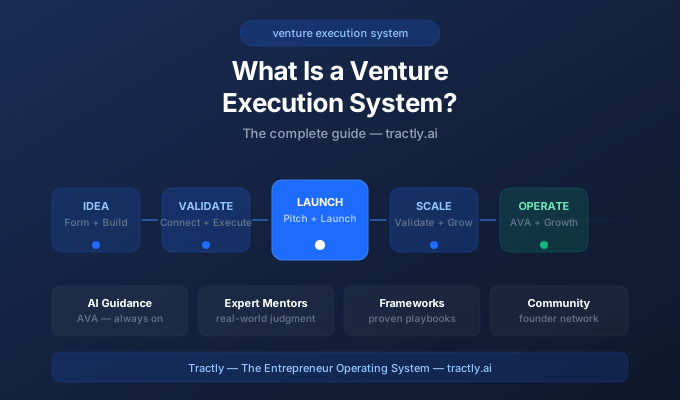
A venture execution system (VES) is a structured platform that combines strategy, AI guidance, expert mentorship, proven frameworks, and community accountability to help entrepreneurs build and launch ventures with clarity and momentum.
Unlike a project management tool, which tracks tasks, or a business course, which delivers information, a venture execution system ties the entire entrepreneurial journey together — from the first moment of ideation all the way through launch and growth.
Think of it as the operating system for your venture. Just as your computer's operating system coordinates hardware, software, and user input into a coherent experience, a venture execution system coordinates your strategy, execution, mentorship, and community into a structured path forward.
The key components of an effective venture execution system are:
- A structured stage-by-stage journey with clear milestones at each phase
- AI guidance that adapts to where you are and recommends the next best action
- Expert mentors who provide real-world judgment at the moments that matter most
- Proven frameworks that remove the guesswork from each stage of growth
- A connected community of founders who hold you accountable and share what's working
When these five elements work together, execution stops being chaotic and starts being systematic.
Who Is This For?
Whether you're a first-time founder trying to validate your first idea, a serial entrepreneur who wants to move faster on your next venture, a corporate innovator bringing startup thinking inside a large organization, or a student learning to build something real — a venture execution system was built for you.
The common thread isn't industry, company size, or funding status. It's the gap between having a vision and knowing exactly how to execute it. If you've ever felt overwhelmed by the complexity of building something new, a structured execution framework is the missing piece.
Why Most Startups Fail Without One
The data is clear. A study of failed startups found that 38% ran out of cash, 35% had no market need, and 20% were simply outcompeted. But beneath those surface causes lies a single root problem: unstructured execution.
Founders without a system face the same four traps:
They build alone. Without guidance, blind spots go unchecked. Decisions get made in a vacuum. Small mistakes compound into costly pivots. The isolation of solo building is one of the most underrated killers of early ventures.
They have no roadmap. When you don't know what stage you're in or what comes next, momentum dies in ambiguity. Every week becomes a question of “what should I be working on?” instead of “let me execute the next milestone.”
The system is fragmented. Accelerators are exclusive and cohort-driven. Online courses are theoretical and passive. Mentorship is inconsistent and hard to access. Tools are disconnected. No single platform supports the full founder journey from idea to operating company.
They confuse motion with momentum. Busy founders who lack a system mistake activity for progress. They build features nobody asked for, attend networking events that lead nowhere, and produce content that doesn't convert — all while their core execution stalls.
A venture execution system solves all four of these problems by design.
The 5 Components of an Effective Venture Execution System
1. A Structured Stage-by-Stage Journey
Every venture moves through predictable stages — ideation, validation, building, connecting with mentors, executing, becoming investor-ready, launching, and operating. A good execution system maps these stages explicitly, with defined entry criteria, clear milestones, and measurable success metrics at each phase.
This structure eliminates ambiguity. Instead of asking “what should I be doing?” founders ask “what does this stage require?” The answer is always clear.
2. AI Guidance That Adapts to You
Static advice doesn't work for dynamic ventures. The best venture execution systems use AI to deliver personalized, always-on guidance that adapts to where you are in your journey.
This means more than answering questions. It means detecting gaps in your strategy, recommending the next best action based on your specific context, alerting you when key metrics deviate from expected trajectories, and learning your venture over time so guidance becomes increasingly precise.
3. Expert Mentors at the Right Moments
AI accelerates. Humans refine. The most critical decisions in a venture — a major pivot, a capital conversation, a key hire, a pricing change — require human judgment, not just data.
An effective venture execution system gates mentor access to the moments when it matters most. Rather than generic advice from a cold introduction, mentors engage when you're genuinely ready and the conversation can move the needle.
4. Proven Frameworks for Every Stage
Reinventing the wheel at each stage of a venture is one of the most expensive mistakes a founder can make. Proven frameworks — validated playbooks built from real startup experience — remove the guesswork from execution.
From idea validation and MVP development to go-to-market strategy and investor readiness, frameworks provide the structure to move quickly without sacrificing quality. They don't replace creativity — they give creativity a structure to operate within.
5. A Connected Founder Community
The most undervalued component of any venture execution system is community. The right people around you — founders who are one step ahead, peers who are building alongside you, and a network that can open doors — accelerate everything.
Community provides accountability, honest feedback, and the kind of support that no AI or framework can replicate. When a founder community is embedded inside the execution system, rather than existing as a separate platform, the compounding effect is significant.
A Venture Execution System vs a Startup Accelerator
The comparison most often made is between a venture execution system and a traditional startup accelerator like Y Combinator, Techstars, or a local cohort program. Here's how they differ:
| Accelerator | Venture Execution System | |
|---|---|---|
| Access | Selective — 1–3% acceptance rate | Open to any founder |
| Equity | Takes 5–10% of your company | No equity |
| Schedule | Fixed cohort — 3 months | Your own timeline |
| Stage | Usually post-MVP | Idea through operating |
| Mentors | Assigned, limited sessions | Unlocked by your progress |
| AI guidance | None or minimal | Built in, always on |
| Community | Cohort only | Ongoing network |
| Cost | Equity + time | Subscription |
The accelerator model was built for a world where access to mentors, networks, and capital was genuinely scarce. That world still exists for the top 1% of ventures that make it through the most competitive programs. But for the vast majority of founders, a venture execution system offers more flexibility, broader access, and no equity dilution.
How a Venture Execution System Works in Practice
Let's walk through what using a venture execution system actually looks like for a first-time founder.
Stage 1 — Idea to validation. You enter with a raw idea. The system guides you through problem definition, customer identification, and assumption mapping. AI helps you craft a problem statement and identify who you're actually building for. You leave this stage with clarity — not just excitement.
Stage 2 — Building and testing. You validate the problem, prototype the solution, and conduct your first real customer conversations. Frameworks guide the process. AI flags the gaps. You build confidence before committing capital to a full product.
Stage 3 — Connecting with mentors. Once you've demonstrated enough traction and clarity, you unlock access to experienced operators. This isn't a cold introduction — it's a matched conversation based on your actual progress and the specific challenge you're facing.
Stage 4 — Executing. You refine your product, finalize your go-to-market strategy, model your financials, and lock down your brand identity. AI guides decisions. Frameworks provide structure. The community holds you accountable.
Stage 5 — Becoming investor-ready. You assemble your investor-readiness package, rehearse your Q&A, and prepare your data room. The system tracks your readiness across eight dimensions and tells you exactly where you need to improve.
Stage 6 — Approaching capital conversations. You approach investor conversations with your data room pre-assembled, your narrative refined, and your readiness confirmed. The system doesn't just prepare you — it helps you track those conversations and follow through.
Stage 7 — Launching. You execute your go-to-market plan, manage early relationships, and track growth metrics. The system transitions from a launch guide to an operations partner.
Stage 8 — Operating. Post-launch, the system becomes your company brain. AI learns your specific business, detects weekly signals, generates 90-day priority plans, and builds a continuously improving model of your venture over time.
Investor Readiness — Not Investor Promises
Because a venture execution system touches the capital stage, it's worth being precise about what it does and doesn't do.
A venture execution system does not broker investor introductions, make capital outcomes certain, or represent founders in placement arrangements. That's not what it's for.
What it does is build the foundation that makes you genuinely investor-ready — so that when you approach capital conversations, you do so from a position of preparation and strength, not improvisation.
Founders who have validated their idea, built a real prototype, tested with actual customers, structured their legal foundation, and assembled a clear investor-readiness package are in a fundamentally different position than founders who are pitching a slide deck built on hope. A venture execution system gets you from the second group to the first. What you do with that readiness is entirely up to you.
The Tractly Venture Execution System
Tractly is the entrepreneur operating system built on this exact model. It combines AVA (your AI Venture Advisor), expert mentors, proven frameworks, and a connected founder community into one structured platform — supporting the full entrepreneurial journey from first idea through operating a growing business.
What makes Tractly different from other platforms isn't any single feature. It's the integration. Every element of the system — the AI, the mentors, the frameworks, the community, and the stage-by-stage journey — works together to eliminate the execution gap that kills most ventures before they ever reach their potential.
Whether you're validating your first idea or getting investor-ready for your next round, Tractly gives you the structure, support, and momentum to execute with confidence. Just getting started? Tractly for Founders walks you from idea to launch. Already running a business? Tractly for Businesses helps you grow more systematically.
For post-launch businesses, the Tractly Operator tier becomes a living company brain — learning your specific business, detecting signals, and generating 90-day priorities that improve over time.
Ready to see it in action?
Apply for Pilot Access to Tractly and start executing your venture with AI guidance, expert mentors, proven frameworks, and a connected founder community.
Apply for Pilot Access →Frequently Asked Questions
What is the difference between a venture execution system and a CRM?
A CRM (Customer Relationship Management system) manages customer and sales data. A venture execution system manages the full entrepreneurial journey — from idea validation through capital readiness and operations. They solve different problems and operate at different levels of the business.
Can a venture execution system work for non-tech startups?
Yes. A venture execution system works for any type of business — retail, services, e-commerce, creative industries, or technology. The core stages of validation, building, launching, and operating apply universally.
How long does it take to see results from a venture execution system?
Most founders report meaningful clarity within the first two to four weeks — a defined problem statement, a validated customer profile, and a clear next step. Tangible business results like first customers or a completed investor-readiness package typically follow within two to four months, depending on stage and commitment.
Is a venture execution system only for early-stage founders?
No. Entrepreneurs can enter a venture execution system at any stage. Existing business owners use it to strengthen strategy and execution. Growth-stage companies use it to become investor-ready. Post-launch businesses use the Operator tier for ongoing intelligence and planning.